
 Agentic AI
 Accounts Payable
 Order Management
 Transport & Logistics
 Customs Clearance
 Banking and financial services
 Insurance
 Transport & Logistics


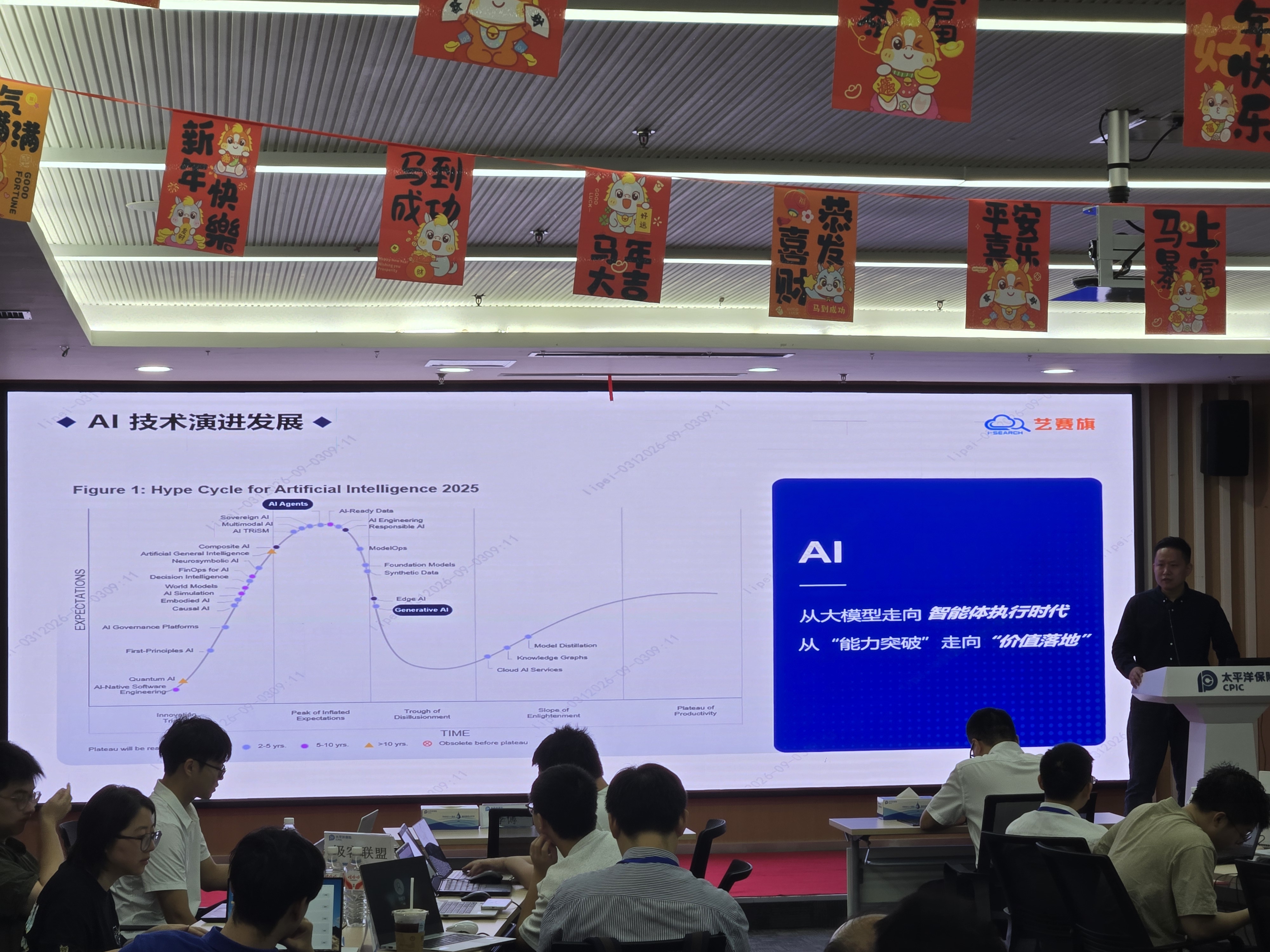
On September 3–4, the 2026 RPA Lights-Out Factory Advanced Exchange Training concluded successfully at CPIC Operations Chengdu Sub-center. The training, aimed at CPIC senior business engineers and prospective senior business engineers, was designed to broaden frontline business engineers' industry perspectives, inspire innovative ideas for business scenarios, and drive the continuous iterative upgrade of CPIC's lights-out factory system. Li Bo, General Manager of the Solutions Department at i-search and Head of the AI Transformation Committee, was invited as the opening keynote speaker for the training. Drawing on trending talent concepts in the industry and CPIC's years of digital intelligence construction practices, he engaged in an exchange of ideas with the trainees on site.
Notably, CPIC's internal "business engineer" team—versatile professionals rooted in the business frontline who also possess automation implementation capabilities—is in fact a typical localized practice of the FDE concept within a large domestic insurance enterprise.
1
What Exactly Is an FDE?
FDE stands for Forward Deployed Engineer. The core responsibility of this role is to truly land technology into business operations, bridging the last mile for AI to enter the enterprise.
FDEs do not sit at headquarters writing code; instead, they embed themselves directly at the business frontline, sit side by side with business teams, and get products running and delivering value in real environments. They must write production code, and also understand Agents, evaluation, and security. They must go deep into customer sites, and also judge which problems are worth solving and which can be set aside.
There is a precise saying: an ordinary engineer uses one capability to serve all customers, while an FDE mobilizes all capabilities for one customer.
An FDE is not a consultant—consultants offer suggestions, while FDEs write code, build systems, and deliver. Nor is an FDE a traditional on-site implementation engineer—implementation engineers deploy according to an established plan, whereas FDEs must discover on site what the plan itself should look like. There is an essential difference between the two.
2
Why Has FDE Suddenly Become So Popular?
The core reason is that the competitive logic of the AI industry has changed.
Two years ago, everyone competed over who had more model parameters, higher rankings on leaderboards, or flashier features. Now, these are no longer enough. Enterprises care about only one thing: can you get into my business and get the job done?
For general-purpose models to land in real business operations, they must connect to industry knowledge, enterprise data, and existing systems, and also withstand organizational accountability, producing stable, acceptable, and continuously improvable results. This cannot be accomplished through remote delivery alone; someone must embed themselves at the business frontline, understand problems face-to-face, design solutions, and drive implementation.
Meanwhile, the traditional path for enterprises pursuing digital intelligence—business submits requirements, IT receives them, back-end development completes them, and then delivery happens—is increasingly unable to keep pace. Business cannot wait, IT cannot keep up, and projects get stuck as they move along. The FDE model offers another path: let the same person master both the language of business and the language of technology. In this way, the "two separate skins" problem naturally disappears.
3
The Real Problem Is Not Tools, but People
Many enterprises have adopted advanced automation platforms, yet projects remain stuck at the pilot stage and cannot scale. Where is the problem? Ultimately, the enterprise itself lacks people who can take the baton.
Once the platform is built, who will create the workflows? Who will maintain them when systems change? Who will handle new scenarios when they emerge? If all these tasks rely on external service providers, the project will forever circle through "deliver—leave—get stuck."
The bottleneck in enterprise digital intelligence lies in the lack of a group of FDE-type talents who are embedded at the business frontline and can translate business requirements into technical implementations. Tools can be purchased, and scenarios can be replicated, but the innovation and continuous iteration that best fit an enterprise's actual circumstances can only come from versatile talents who are physically present at the business frontline.
4
All Large Enterprises Face the Same Problem
As the industry moves from RPA to AI agents, technology becomes increasingly complex. What exactly can enterprises rely on to achieve large-scale implementation?
Copying the internet industry's back-end R&D model will detach from business reality; relying entirely on external service providers makes it difficult to build up one's own digital capabilities. The FDE model offers a viable path: push technical capabilities down to the business side, cultivate a group of "frontline technical practitioners" within the enterprise, break down the wall between business and technology, and let technology truly serve business goals.
Therefore, digital intelligence services for enterprises cannot be merely "delivering software." While delivering tools, it is also necessary to provide accompanying methodologies and training support to help customers cultivate their own "FDE-style" business-technical teams, enabling the enterprise itself to have the ability to discover scenarios and iterate workflows. It is necessary to both provide tools and help customers cultivate people who can use those tools.
This logic holds true in any industry.
5
Technology Will Change, but the Logic of "People" Will Not
No matter how technological forms evolve, the underlying logic—"let those who understand business master technology, and let technology return to business value"—remains unchanged.
The value of the FDE model does not lie in its being a new concept, but in its answer to a real question that all enterprises must face: in the AI era, what kind of people can truly drive technology into business operations?
It is neither IT personnel who passively wait for requirements to be input, nor business personnel who merely raise demands; rather, it is versatile talents who are rooted at the business frontline, who can understand frontline pain points, who can roll up their sleeves to solve problems, and who take responsibility for business outcomes.
If automation is to break out of scattered pilots and move toward generating business value at scale, talent development is an unavoidable part of the journey.